Contribution compensation
Working less, taking leave or starting a new job?
Check what this means for your entitlement to contribution compensation
If you are employed on 1 January 2027, you are entitled to contribution compensation.
The new rules will change how you build up your pension. For some people, this will have a negative effect. Are you around 27 years old or older? Then you are expected to build up less pension in the future than under the old scheme. That is why, at the time of the transition, you will receive a one-off extra amount in your pension pot.
It is good to know how your pension works for you.
Contribution compensation can make a difference. In 6 minutes, you will learn what contribution compensation is and which choices can affect it.
Watch the video below:
These are the most important rules that apply:
- You only receive the amount if you are building up pension with SPF on 31 December 2026 and on 1 January 2027. This means you are an employee of one of SPF’s affiliated employers or became occupationally incapacitated after 2007.
- If you change jobs before 1 January 2027, check whether you will receive contribution compensation from your new pension fund.
- If you start working fewer hours before or from 1 January 2027, your contribution compensation will be lower.
- You will not receive contribution compensation if you take long-term unpaid leave on or before 1 January 2027 and no longer build up pension during that leave. Check with your employer how pension accrual works during your leave.
Frequently asked questions
01. What is contribution compensation?
Contribution compensation is intended to offset the disadvantage that some members face as a result of the transition to the new pension scheme. This disadvantage arises because the redistribution of contributions from young to older members will stop. The compensation helps offset this disadvantage.
02. When are you entitled to contribution compensation?
You are entitled to contribution compensation if you meet these conditions on 31 December 2026 and on 1 January 2027:
- You are employed by an affiliated company of SPF, or you became occupationally incapacitated on or after 1 January 2007.
- You are still accruing pension with Stichting Pensioenfonds SABIC.
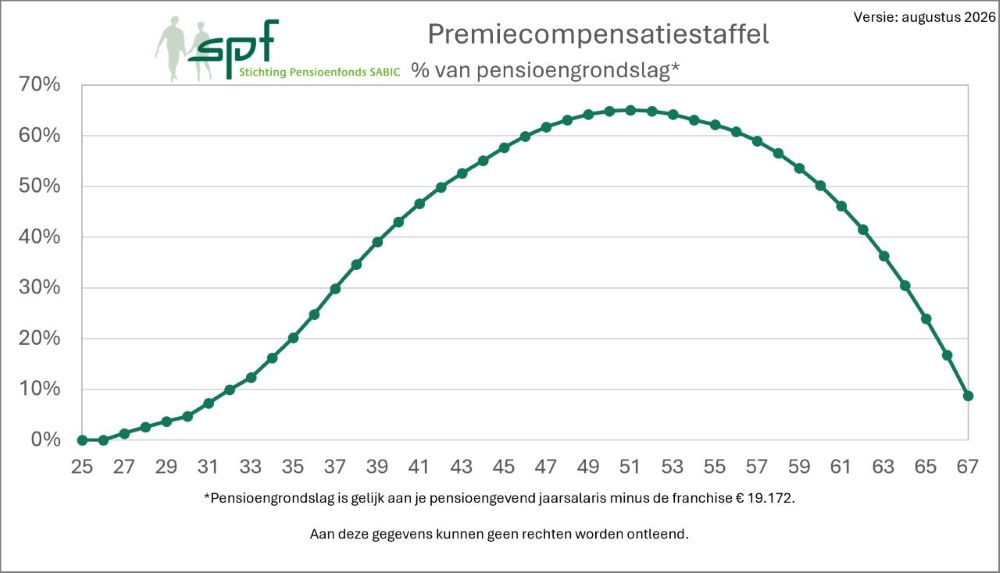
- You meet the age condition. Based on the current scale, this is between approximately 27 and 67 years.
The amount depends on your age and your pension base.
03. What does contribution compensation mean in euros?
The amount of contribution compensation depends on your age and your pension base. In the video, we use Esther as an example. She is 45 years old and has a salary of €80,000. Based on the contribution scale currently known, her contribution compensation is approximately €35,000. If she retires at age 67, we expect this to increase her pension by approximately €2,300 gross per year. Please note: this is an example. We can only calculate the exact amounts early next year.
View more examples with different ages and salaries here.
Look at the age and salary that are closest to your own. This will give you an idea of what contribution compensation means for your pension.
We cannot yet make exact calculations for your contribution compensation. This will only be possible after 1 January 2027. You will receive information about this during 2027 with the final calculation of your new pension
04. When will it be clear how much contribution compensation you will receivet?
The figures in the examples are only intended to give an impression of approximately how much the contribution compensation is and what pension this may provide in the long term. We can only calculate the exact amounts during 2027. You will receive information about this during 2027 with the final calculation of your new pension.
05. Which choices can affect your contribution compensation?
- No longer working for one of the affiliated companies,
- starting to work fewer hours, or
- taking long-term unpaid leave during which pension accrual stops
can affect your entitlement to contribution compensation or the amount you receive.
06. What happens if you leave employment on 1 January 2027
You will then not meet an important condition for contribution compensation from SPF. You must be employed by an affiliated company of SPF on 1 January 2027 and still be building up pension with Stichting Pensioenfonds SABIC. Are you no longer employed, or do you change jobs before 1 January 2027 to an employer that is not affiliated with SPF? Then your entitlement to contribution compensation from SPF will lapse. You may receive contribution compensation from your new pension fund. Please check this with that fund’s helpdesk.
07. What happens if you start working fewer hours before 1 January 2027?
Your contribution compensation will then be lower. This is because the amount of compensation depends, among other things, on your pension base on 1 January 2027. If you start working fewer hours, that pensionable income will be lower, and so will your contribution compensation.
08. What happens if you want to take long-term leave before 1 January 2027?
It is then important to check whether your pension accrual continues during your leave. If your pension accrual stops, you will not be entitled to contribution compensation. In that case, it may be wise to consider whether you can postpone the start date of your leave until after 1 January 2027.
Fictional example of Ellen and Esther:
Ellen has dreamed of travelling the world for years and wants to make that dream come true before 1 January 2027. Her employer allows her to take long-term leave. Together, they agree that her pension accrual will continue during her leave. This option is not automatically available with all employers.
Esther also notices this when she discusses her plans for long-term leave with her employer. In Esther’s case, pension accrual during leave is not possible. If she still takes long-term leave before 1 January 2027, this will affect her entitlement to contribution compensation.
Pension accrual during leave is therefore not automatic. So discuss with your employer whether this is possible if you want to take long-term leave before 1 January 2027.
09. What happens if you stop working before 1 January 2027?
If you stop working before 1 January 2027 and start taking your pension, you will not be entitled to contribution compensation. The compensation is linked to your employment on 1 January 2027. Are you no longer accruing pension on that date? Then you no longer meet that condition. If your pension accrual stops before that date, check under ‘retiring earlier’ what this means for you.
10. Why is there a limit on the salary over which contribution compensation is calculated?
There is a limit on the amount over which contribution compensation is calculated. You only receive contribution compensation for your pension in the basic scheme. This scheme applies up to a pensionable salary of a maximum of €137,800. This limit is set by law for pension accrual. The part of your salary above this amount does not count towards pension accrual in SPF’s pension scheme. That is why contribution compensation is only calculated over the pensionable salary up to this limit, minus the deductible.
Fictional example:
Hans has a pensionable salary of €144,000 per year. For the calculation of contribution compensation, a maximum pensionable salary of €137,800 is taken into account. The salary above this amount does not count.
The deductible is then deducted from this amount (€19,172 in 2026). This brings his pension base to €118,628. His contribution compensation is calculated over this pensionable base.
11. Do occupationally incapacitated members also receive contribution compensation?
Yes, if you became occupationally incapacitated on or after 1 January 2007 and are still accruing pension.
These are the most important rules that apply:
- You only receive the amount if you are still occupationally incapacitated and accruing pension with Stichting Pensioenfonds SABIC on 31 December 2026 and on 1 January 2027.
- Your degree of occupational incapacity on 1 January 2027 determines the amount of your contribution compensation. If you are fully occupationally incapacitated, this is 100%. If, for example, you are 50% occupationally incapacitated, this is 50% of the contribution compensation.
If you also accrue pension with SPF for the part for which you are fit for work, you will of course also receive contribution compensation for that part.
The video also applies for the most part to someone who became partly or fully occupationally incapacitated on or after 1 January 2007. ‘Employed’ means the same as ‘the degree to which you accrue pension’. Working fewer hours is then the same as becoming ‘less occupationally incapacitated’, which means your contribution compensation will be lower.
But if this means you can work more for one of our affiliated employers and earn more, your contribution compensation will actually be higher.
12. Can you calculate contribution compensation for yourself
The exact amounts of contribution compensation will only become final on 1 January 2027. You will see the final amounts during 2027 in the final calculation of your new pension.
Would you like an initial idea of the contribution compensation for your situation and what this means for your pension at age 67? Then look in the table to see which age and salary are closest to your own situation.
Would you like an impression based on your own situation? We calculate contribution compensation over your pensionable income. This is your pensionable salary minus the deductable (the part over which you do not accrue pension because you will also receive state pension). In 2026, this deductable is €19,172. You can find your full-time pensionable salary in ‘Mijn SPF’ under ‘My details’. Deduct the deductable of €19,172 from that full-time pensionable salary. If you work part-time, you must then multiply the result by your part-time percentage. Use the amount that remains to look at the table shown in the video at 3 minutes. Take the contribution compensation percentage that applies to your age and calculate for yourself what contribution compensation you are likely to receive.